
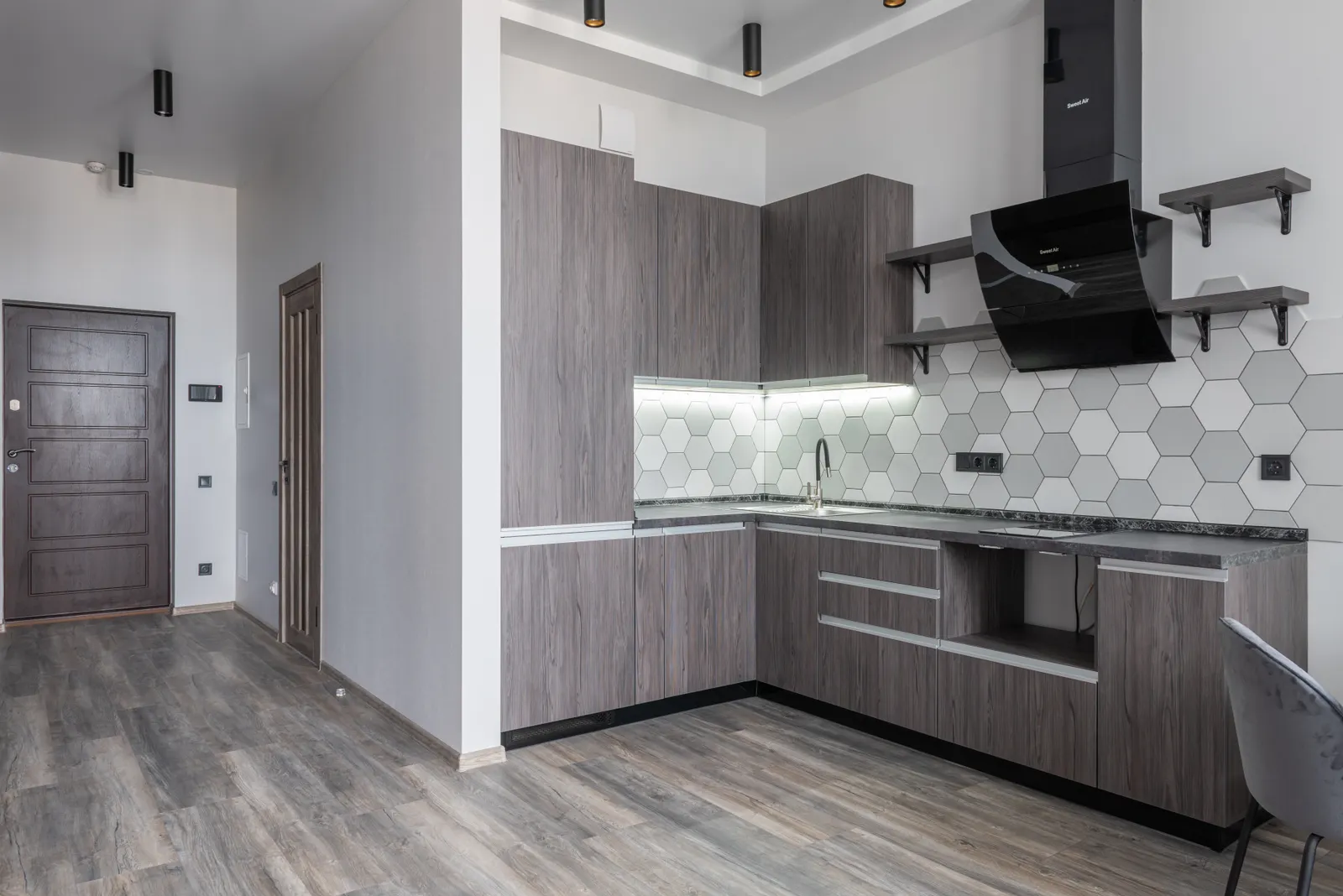
The hood is often chosen after the kitchen elevation looks finished. By then, its route to the outside, filter access or housing may be difficult to accommodate. Start with how the appliance will operate and where the cooking area sits. For a new kitchen or renovation in Saudi Arabia, a documented ventilation decision gives the cabinet maker and installer something definite to coordinate, instead of leaving a visible appliance to conceal an unresolved service arrangement.
Distinguish the two operating modes
A ducted arrangement discharges air through a route to the outdoors. A recirculating arrangement returns air through the appliance's specified filters; IKEA's Saudi guide describes this option where an external connection is unavailable. These are different configurations, so verify the exact model and required accessories. Do not assume that a hood pictured with a chimney has a completed external route, or that a filter kit is included in the base price. Put the chosen mode on the kitchen drawing.
Describe the cooking routine before selecting equipment
Tell the designer which hob you plan to use, how frequently you cook and whether the kitchen is open to the family sitting area. Include the pots and cooking activities that matter to your household. EPA guidance notes that cooking can generate particles and recommends effective ventilation, including an externally vented hood where possible. Use this as a reason to plan extraction carefully, not as a substitute for selecting equipment against the actual room and installation conditions.
Establish a real route to the outside
Ask the responsible mechanical professional to show the proposed route, termination and coordination with other services. Have the installer confirm the duct arrangement against the selected manufacturer's instructions. Identify who is responsible for openings and reinstating affected finishes, and obtain any required project permissions before work begins. Do not leave the route as an arrow that disappears above the ceiling. If a feasible route has not been confirmed, keep that decision open rather than pricing the kitchen as fully resolved.

Coordinate the hood and cabinetry as one detail
Provide the cabinet maker with the final appliance reference and current installation drawing. Review its relationship to the hob, upper cabinets, lighting, wall finish and ceiling. Required clearances come from the relevant appliance instructions and project requirements, not a generic image. Confirm how the unit is supported and how filters, lights or other serviceable parts are reached. A decorative enclosure should be reviewed in both its closed appearance and its maintenance position before the joinery is manufactured.
Review controls and noise in everyday use
Ask for an explanation of the available operating settings and the basis of any sound or airflow figures. Compare equivalent operating conditions rather than treating the largest advertised number as the only criterion. Consider who will reach the controls and whether the appliance is practical to operate during normal cooking. If a showroom demonstration is available, note which setting you hear. It is useful product information, while the completed installation still needs its own appropriate functional checks.
Price the maintenance arrangement
List the filters and accessories required for the chosen mode, their product references and the manufacturer's care or replacement instructions. Ask how replacements can be sourced and how the cabinet permits access without dismantling unrelated finishes. Avoid assigning one cleaning or replacement interval to every product. Include access panels and any separate control components in the quotation. This makes the ownership decision clearer than a comparison limited to the appliance's purchase price and a photograph of its front face.
Verify the installed system before handover
Have the installer demonstrate the controls and explain the completed route or filter configuration. Record the installed model, operating mode, accessories and any specified commissioning results. Review the agreed finishes and access arrangements with the cabinet maker present if necessary. Keep operating instructions where the household can find them. If performance seems unsatisfactory, record the cooking condition and setting used and arrange an appropriate inspection; adding a larger appliance without reviewing the existing arrangement may miss the underlying issue.
Your practical checklist
- Record the hob, cooking routine and open-plan connections.
- Confirm ducted or recirculating operation for the exact model.
- Show the complete external route where ducted extraction is planned.
- Coordinate clearances, supports, controls and filter access with cabinetry.
- Keep accessory references, care instructions and commissioning records.
Frequently asked questions
Is a recirculating hood the same as extracting outdoors?
No. The air paths differ. Ask the designer to explain what the selected system does and which requirements apply to your kitchen rather than treating the two modes as interchangeable.
Can I finalize the cabinets before choosing the hood?
Keep the relevant cabinet detail provisional until the actual model and arrangement are coordinated. Dimensions, access and service connections should be resolved before manufacturing the enclosure.
Does an electric hob remove the need to plan extraction?
Cooking itself is relevant to particle generation, not just the presence of a flame. Include ventilation in the kitchen design and have the appropriate professional assess the proposed equipment and arrangement.
Sources and further reading
Sources support the specific facts identified below. Planning examples and checklists are editorial guidance; photographs are illustrative.
- IKEA Saudi Arabia: extractor hoods and filters guide — Supports the distinction between an external duct connection and recirculation using specified filters.
- US EPA: sources of indoor particulate matter — Supports the narrow point that cooking produces particles and ventilation is relevant. No airflow rate, health promise or Saudi compliance criterion is inferred.