
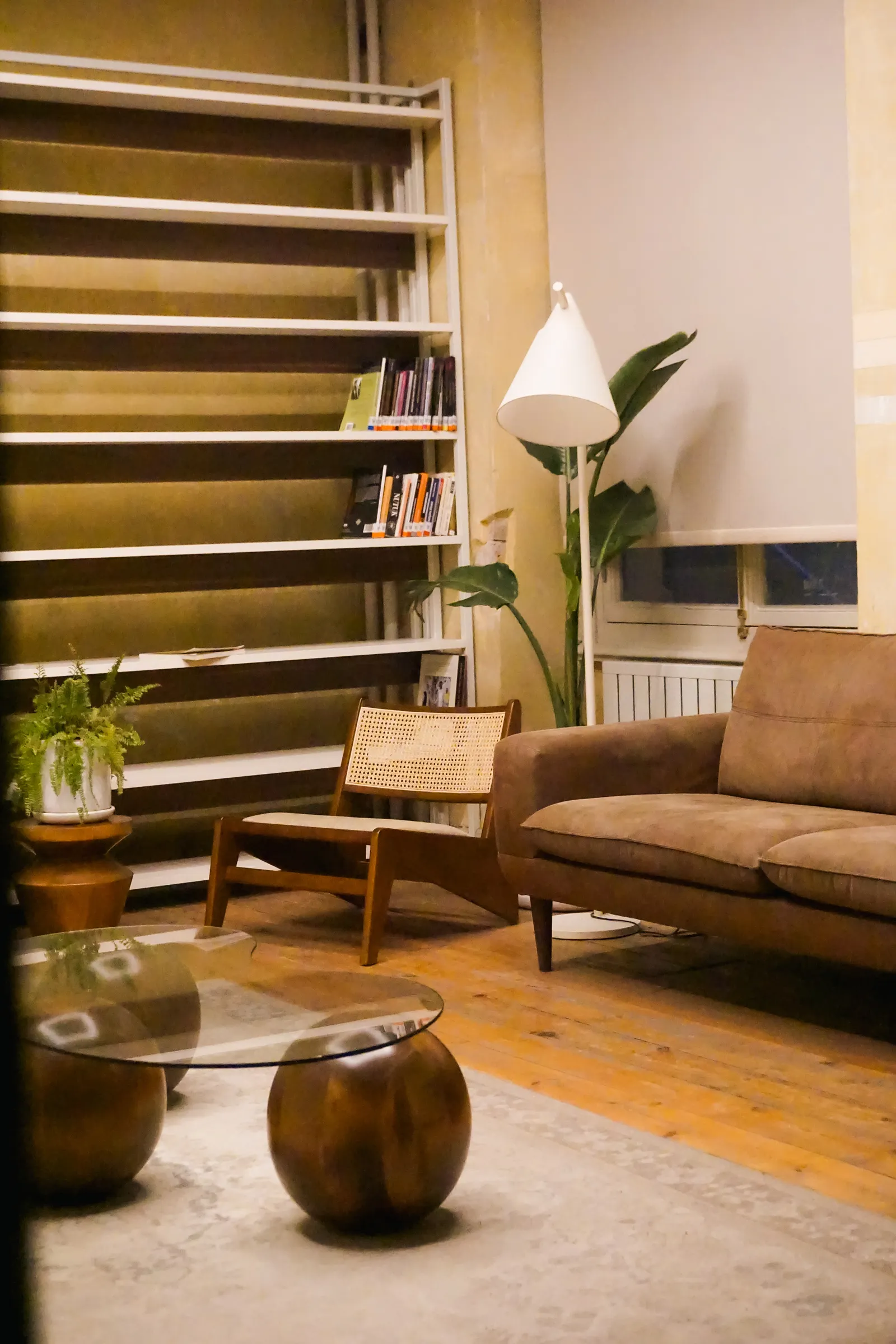
A serving table should make hospitality easier from the seats you actually use. Its length, depth, height and position matter together. A table that looks proportionate in a photograph may be awkward to reach or difficult to pass when the room is occupied. Start with your seating arrangement and serving routine, then compare table options in the complete room rather than choosing a matching piece by appearance alone.
Map the serving sequence
Describe where drinks and food enter the room, where trays are set down and how used items are collected. Include the person serving, not only the seated guests. A useful surface near the entry may reduce repeated movement through the seating group. Decide what must remain on the table during a visit and what can stay elsewhere. This prevents decorative objects from occupying the space needed for actual hospitality and helps you choose the number of tables.
Test reach from the actual seat
Use the intended seating height and depth when testing a table. Sit normally and consider reaching a cup, placing a plate and standing again. Do not select height solely from a photograph of a different sofa. A mixed-height majlis may need more than one kind of surface. Ask the supplier for the exact dimensions of the chosen table and try a comparable physical arrangement where possible. The goal is convenient use without repeatedly leaning or moving furniture.
Compare shapes against circulation
A rectangular, round or nested table changes how people move around the seating group. Test the shape along the actual route to each seat and the door. Rounded forms are not automatically suitable if their overall diameter occupies the route; a narrow rectangle is not automatically convenient if its ends obstruct access. Draw the full outline, including legs or projections where relevant. Compare the table as a volume people use around, not only the area of its top.
Evaluate several smaller surfaces
Compare one central table with side tables or movable serving pieces. Smaller surfaces may distribute access more evenly, but they also need defined parking positions and storage if not always used. IKEA’s Saudi coffee-table range includes different configurations; the useful comparison is the actual chosen product dimensions, not a generic category. In a hypothetical long majlis, two surfaces might serve separate ends more conveniently than one centrepiece, provided the serving route remains clear.
Choose a surface you can maintain
Ask for care instructions for the exact material and finish. Consider the drinks, trays and cleaning routine the household uses, without assuming all stone, timber or coated surfaces behave alike. Check how joints, edges and any lower shelf will be cleaned. If the table includes storage, test whether it remains accessible when guests are seated. Decorative appeal matters, but a serving piece should also support the practical routine that will be repeated after every visit.
Approve the arrangement with the room occupied
Review the final table placement with all regular seats represented and the likely number of guests in mind. Check arrival, serving, reaching and departure, including a person passing while someone stands. Remove unnecessary decorative items during the test so you understand the usable surface. Confirm product references and delivery terms before buying. The right arrangement is not necessarily the largest table or the fullest set; it is the one that supports your hospitality with manageable movement and care.
Your practical checklist
- Describe how trays enter and used items leave.
- Test reach with the actual seating height.
- Check full table shapes against walking routes.
- Give movable tables a place when unused.
- Review care instructions for the chosen finish.
Frequently asked questions
Must the coffee table match the sofa’s length proportionally?
Proportion can help visual balance, but it does not replace testing reach and movement. Use the actual arrangement rather than treating a decorative ratio as a universal rule.
Are nesting tables suitable for every small majlis?
Only if they have useful positions when separated and a convenient place when grouped. Test both states, including how people move around them during serving.
Can I use side tables instead of a central one?
Yes, if every required activity still has a convenient surface. Check access from the seats and avoid placing the tables where guests need to enter or stand.
Sources and further reading
Sources support the specific facts identified below. Planning examples and checklists are editorial guidance; photographs are illustrative.
- IKEA Saudi Arabia — Coffee tables — Compare actual table configurations.